

Search Intent and Keyword Mapping: From List to Content Plan
A keyword list becomes useful only when each term has a page, an intent and a reason to exist. Mapping is where research turns into a plan.
A keyword list becomes useful at the moment each term is assigned to a page, an intent and a reason to exist. Before that, it is a pile of demand. After that, it is a content plan you can schedule, write and measure. Mapping is the step most small teams skip, and it is the reason so many sites have three pages arguing for the same search.
This guide turns a raw list into a mapping sheet, then shows how to keep it accurate as the site grows.

The four intent types that matter
Most queries fit one of four jobs. Informational queries want an explanation or a process. Navigational queries want a specific site or brand. Commercial queries want a comparison before buying. Transactional queries want to complete an action, such as booking, downloading or paying.
Intent is not a property of the word alone; it is a property of the word plus the results page. "Best laptop" is commercial because the results are reviews and comparisons. "Laptop repair near me" is transactional because the results are local service pages. Always confirm with the live results before you assign a format.
- Informational: guide, explainer, tutorial, checklist.
- Navigational: brand page, login, documentation home.
- Commercial: comparison, review, alternatives, pricing.
- Transactional: product, booking, signup, download, quote.
Group close variants before mapping
Close variants are phrases that describe the same job and expect the same page. "Website backup plan", "how to back up a website" and "website backup checklist" can usually live on one strong guide. Grouping them concentrates authority and avoids thin duplicates.
Do not group phrases that need different formats. A generator, a template and a service page are different jobs even when they share a noun. When in doubt, read the top results for each phrase side by side. If the pages look structurally different, the searcher expects something different.
One primary keyword per page
Every page gets one primary phrase, written into the title and the opening paragraph, plus a small set of secondary phrases that belong in the outline. The primary phrase is the promise. The secondary phrases are the details that make the page complete. If you cannot name the primary phrase in one line, the page is not ready to write.
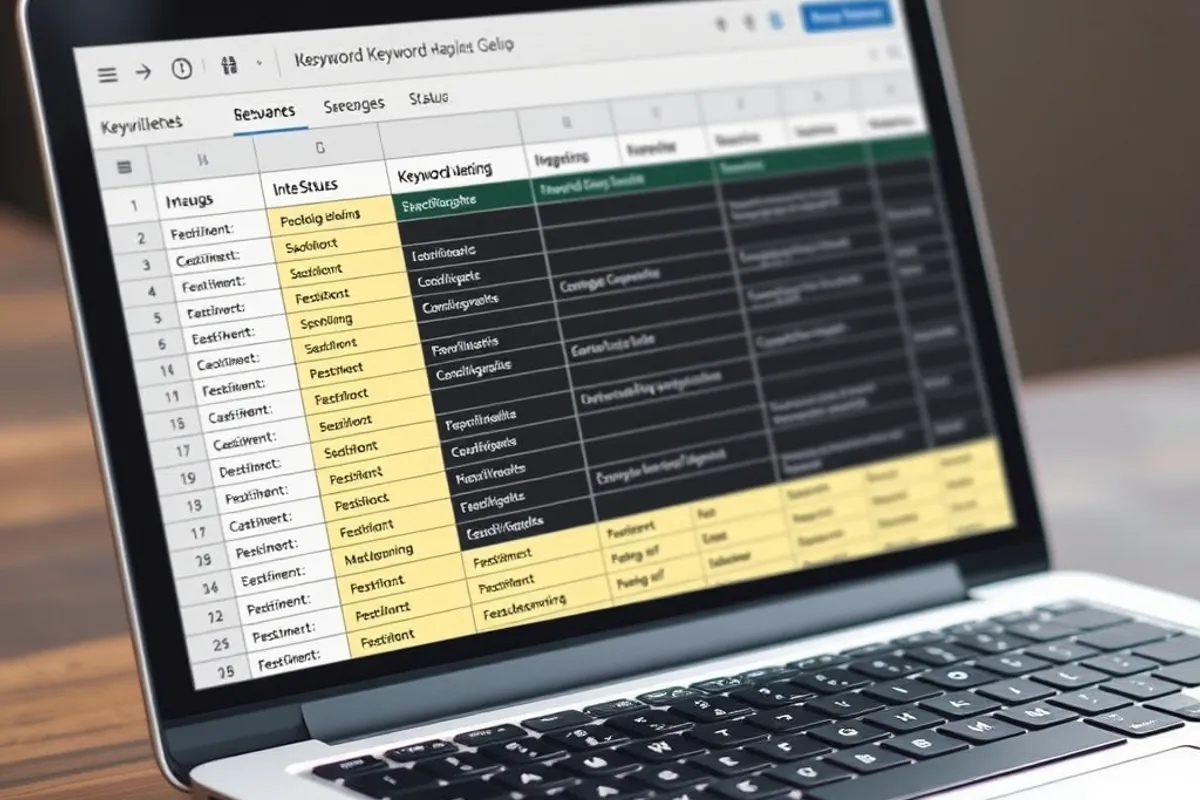
Write the mapping sheet with these columns: page URL, primary keyword, intent, secondary keywords, funnel stage, owner and status. That is enough to plan a quarter of content without a project management tool. Add a column for the internal links the page needs, because links are part of the plan, not an afterthought.
Avoid cannibalisation
Cannibalisation happens when two pages target the same intent. Search engines pick one, usually the wrong one, and both pages underperform. The symptom is familiar: a page ranks for a phrase it was not written for while the intended page sits on page three.
Fix it by merging or redirecting. If two pages answer the same job, combine the strongest sections into one page, redirect the other and update internal links. If they answer different jobs, rewrite the titles and openings so the difference is obvious. Do not solve cannibalisation by adding more keywords to both pages; that makes the overlap worse.
Every page should have one job. When two pages share a job, one of them is a redirect waiting to happen.
Omar Haddad
Map the whole journey
A content plan that only covers informational queries attracts readers who are not ready to act. A plan that only covers transactional queries has no audience to sell to. Map the journey: problem, options, decision, action. Each stage needs at least one page, and each page needs a link forward to the next stage.
For a small site, that might be one explainer, one comparison, one pricing page and one signup page per core topic. Ten articles across five topics can cover the journey well. More pages are not automatically better; a complete path is.
Key facts
- Four intents: informational, navigational, commercial, transactional.
- Group variants that share a job and a format.
- One primary keyword per page, written into the title.
- Merge or redirect pages that target the same intent.
- Cover problem, options, decision and action for each topic.
Build and maintain the mapping sheet
Keep the sheet in one place and make it the source of truth. When a writer starts a page, the row moves to "drafting". When it publishes, add the URL and the publish date. When a query starts bringing impressions for a different page, log it and review at the end of the month.
Review the sheet monthly for status and quarterly for structure. Monthly review catches pages that are stuck. Quarterly review catches pages that should be merged, split or retired. The sheet should be short enough to read in one sitting; if it takes an hour to understand, it has become a database rather than a plan.

When to split or merge
Split a page when it ranks for two unrelated intents and neither section gets read. Merge when two pages share a job and neither has enough depth alone. The signal is usually in the search queries: if one page receives clicks for a phrase that belongs to another page, the mapping is wrong.
After a split, add internal links from the original page to the new one and update the mapping row. After a merge, redirect the weaker URL and keep the stronger content. Either way, tell the sheet what happened, or the next person will repeat the work. For the research step that feeds this sheet, see our beginner keyword research workflow.

Final word
Mapping is a small discipline with a large effect. It stops duplicate pages, clarifies what each article is for and gives every writer the same brief. Keep one primary keyword per page, one intent per row and one clear next step in the journey. Then the content plan becomes something a small team can finish.
If the pages are live but not converting, the next step is not more keywords. Read our guide to conversion rate optimization and fix the path from search to action. For the technical rules behind indexing and canonical URLs, the Google Search Central documentation is the reference to follow.